

Dziennik · 07.10.2026 · 4 min czytania
Crystal and glass - what 24% lead oxide changes
Crystal is glass, yet not every glass may carry that name. The difference lies in lead oxide, which changes the weight, the brilliance and the way the material takes a cut. This is the material a HolyVerre crystal urn is made of.
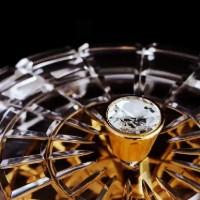
Crystal is glass, yet not every glass may carry that name. The difference lies in composition, and more precisely in the share of lead oxide in the glass. A HolyVerre crystal urn is made of glass that contains 24% of it.
Crystal is glass of a defined composition
Ordinary glass is made of quartz sand, soda and limestone, melted at high temperature. In crystal, part of these ingredients is replaced by lead oxide, which changes the properties of the whole material. Despite its name, crystal has no crystalline structure and remains glass, only a nobler one.
The name comes from rock crystal, the clear quartz that for centuries was held as the measure of purity. Glassmakers looked for a material just as clear, yet one that could be formed and cut. They found it in seventeenth-century England, when lead oxide was added to the glass.
The law defines what may be called crystal
The name is protected by law. European Directive 69/493/EEC divides crystal glass into categories and sets requirements for each.
- full lead crystal - at least 30% lead oxide
- lead crystal - at least 24% lead oxide, density of at least 2.90 g/cm³, refractive index of at least 1.545
- lower categories of crystal glass - lead may be replaced by oxides of barium, zinc or potassium
The 24% threshold is therefore the line at which glass becomes lead crystal. Below that line the material can be clear and beautiful, yet it lacks the same weight, brilliance and sound.
Lead oxide changes weight, light and cut
Weight
Lead is a heavy element, so crystal weighs clearly more than ordinary glass of the same volume. A piece from the Crystal Collection weighs 8.15 kg, and that weight is felt in the hands. It gives a sense of permanence, dignity and presence.
Light
Crystal refracts light more strongly than ordinary glass and splits it into colors. A ray enters the form, reflects off the facets and returns as a flash. Every change in the surroundings changes the look of the crystal, which seems to move with the light.
Ordinary glass lets light through almost unchanged, which is why it appears calm and flat. Crystal holds it, breaks it and gives it back, and by candlelight or in the sun it scatters colored reflections.
Cut
Lead oxide makes the glass softer and more responsive to the tool. This allows deep, sharp facets to be cut into it and then polished to full clarity. Ordinary glass will not take such a cut, it chips or stays matte. The whole process is described in the post how a crystal urn is made.
Sound
Lead crystal, struck lightly, answers with a clear, long tone. Ordinary glass gives a short, dull sound that fades almost at once. It is a less visible trait, yet for centuries it has served to tell the two materials apart.
Crystal is recognized by weight, brilliance and edge
True crystal can be told from glass without a laboratory, with hands, light and attention.
- weight - crystal is clearly heavier than its size suggests
- brilliance - in the light there are colored reflections, not only a bright glare
- edge - hand-cut facets are sharp and distinct, while in pressed glass they are rounded
- sound - the tone after a light strike is long and clear
Crystal and ordinary glass in numbers
- ordinary glass - density of about 2.5 g/cm³, refractive index of about 1.52
- 24% lead crystal - density of at least 2.90 g/cm³, refractive index of at least 1.545
Lead crystal is safe and lasting
In crystal, lead oxide is permanently bound into the structure of the glass and is not released by touch. Reservations apply only to vessels in which drinks are stored for a long time, not to objects of remembrance. A crystal urn therefore remains safe in the funeral home, in the columbarium and in the hands.
Crystal does not dull, does not yellow and does not lose its clarity over the years. It asks only for care, a soft cloth and protection from impact.
A crystal urn requires true crystal
A form cut by hand, facet by facet, makes sense only in a material that answers to light. That is why the HolyVerre manufacture uses only crystal glass containing 24% lead oxide. Crystal stands for the soul - pure, luminous and present in every flash.
It is a material chosen not for ornament, but for the light it is able to hold.