


Dziennik · 06.10.2026 · 3 min czytania
How a crystal urn is made - five stages of work
A crystal urn is made in five stages, and each of them is carried out by hand. Cutting, porcelain forming, gilding, polishing and inspection come together in a piece that has no copy
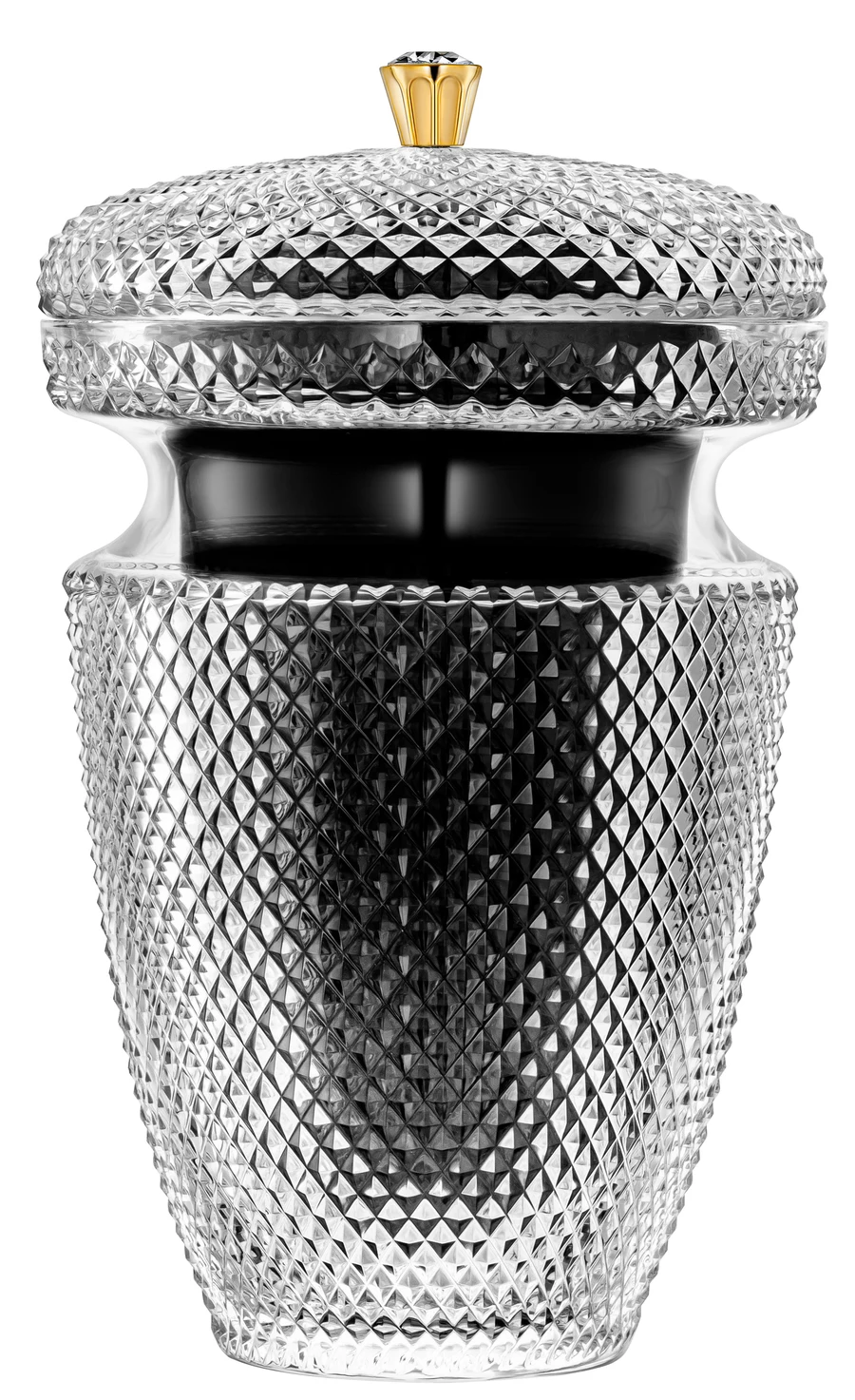
A crystal urn is made in five stages, and each of them is carried out by hand. At the HolyVerre manufacture these are crystal cutting, porcelain forming, gilding, polishing and inspection. None of the stages resembles serial production, which is why every piece leaves the atelier slightly different.
What a crystal urn is made of
The material is crystal glass containing 24% lead oxide, which makes it crystal in the strict sense of the word. Lead oxide gives the glass its weight, its clarity and its power to refract light. Inside the crystal form sits a porcelain core, which gives the piece its color. Crystal stands for the soul, and porcelain stands for life, delicate and fragile.
Stage one - cutting the crystal
The cut is made by hand, facet by facet, until the form begins to split the light. The angle and depth of each cut decide how the crystal will answer its surroundings. The Crystal Collection has three cuts, named Gabriel, Uriel and Sariel. Each one leads the light differently, though all are made by the same method.
Stage two - forming the porcelain
The porcelain core is formed by hand and then fired, so that it gains hardness and durability. Enclosed in crystal, it stays visible from every side and changes with the light. The core comes in one of seven colors.
- Golden Light
- Platinum Light
- White Pearl
- Black Pearl
- Pink Rose
- Green Aura
- Sapphire Soul
Stage three - gilding
Gold and platinum are laid on by hand and then fixed by fire. After firing, the metal bonds permanently with the surface and keeps its brilliance. The lid is crowned with a handle or a cross, finished in gold or in silver. Laid on by hand. Fixed by fire.
Stage four - polishing
After cutting, the surface of the crystal remains matte, and only polishing restores its full clarity. The work covers every facet, until the edges are clean, even and distinct. Then light passes through the form freely and begins to move within it.
Stage five - inspection
The finished piece goes through an inspection that covers the crystal, the porcelain and the decoration. The permitted dimensional tolerance is ±2-3 mm, because work done by hand does not repeat to the millimeter. Every piece leaves the manufacture with a certificate of authenticity, bearing a holographic seal and the founder’s signature.
The crystal urn in numbers
- height 37.5 cm, 38.5 cm with the cross
- width 24.5 cm
- capacity 3.8 l
- weight 8.15 kg
- crystal glass containing 24% lead oxide
A piece that has no copy
Five stages and many hours of work lead to a single object. It is a memorial for someone who deserves more than a thing made in series.