

Journal · 10/18/2026 · 10 min read
Hand-Formed Porcelain Urn
Porcelain begins as white clay and water and ends in the heat of the kiln. Here is how a porcelain urn is made, and why the craftsman's hand is present at every stage.
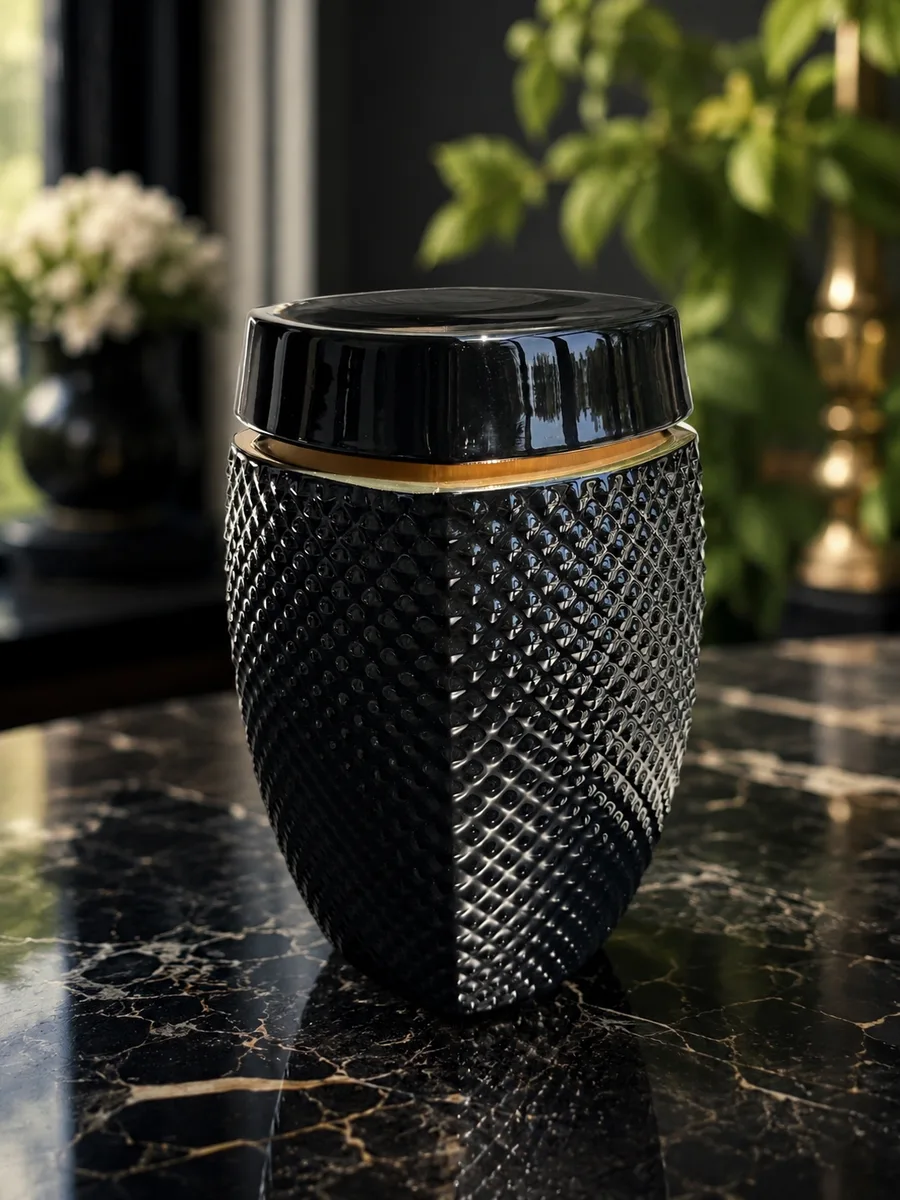
A porcelain urn is one of the oldest and most refined ways to preserve the memory of a loved one. Smooth, white and cool to the touch, porcelain has been associated with purity, peace and permanence for centuries. Behind its quiet, harmonious appearance, however, lies a process that demands patience, experience and many hours of skilled handwork – from preparing the clay body, through forming and drying, to several firings in the kiln.
In this article we look step by step at how a hand-formed porcelain urn is made, how porcelain differs from other ceramic materials, and why it has been chosen for centuries for objects meant to last for generations.
A short history of porcelain
Porcelain was born in China more than a thousand years ago. For centuries its recipe was a closely guarded secret, and pieces brought to Europe along the Silk Road and by sea fetched prices comparable to gold. It was not without reason that porcelain was called “white gold”.
European alchemists and scholars spent a long time trying to uncover the Chinese secret. They succeeded only at the beginning of the 18th century in Saxony – in 1710 the Meissen manufactory was founded, the first in Europe to produce true hard-paste porcelain. Soon other manufactories appeared across the continent, including in Poland, where the Ćmielów works began operating at the end of the 18th century.
Since then porcelain has been the material of exceptional objects: tableware for special occasions, sculptures, vases and commemorative vessels. Today the same tradition of craftsmanship lives on in objects of remembrance – including urns.
Porcelain and other ceramic materials
Not all ceramics are porcelain. Every ceramic object is made from clay fired in a kiln, but they differ in the composition of the clay body and the firing temperature – and therefore in their appearance and durability.
- Earthenware and everyday pottery are fired at lower temperatures. Their body remains porous and absorbs water unless glazed.
- Stoneware is harder and denser, but usually has a greyish or beige tone and does not let light through.
- Porcelain is ceramics of the highest grade. Fired at the highest temperature, it becomes white, hard, dense and almost completely non-porous. In thin areas it is delicately translucent.
It is this combination of whiteness, hardness and resistance that makes porcelain so well suited to a memorial piece.
What porcelain is made of
The basis of porcelain is kaolin – a very pure white clay whose name comes from Gaoling, a hill in China. Kaolin gives the body its plasticity and whiteness. It is complemented by two further ingredients:
- feldspar, which melts during firing and binds all the particles into a uniform, glassy structure,
- quartz, which stabilises the shape and gives porcelain its hardness.
The proportions of these three ingredients determine the whiteness, strength and translucency of the finished piece. Even a small change in the recipe can give porcelain a different tone or make it behave differently in the kiln.
Preparing the porcelain body
Before the first shape is made, the raw materials must be carefully prepared. The ingredients are ground into a very fine powder and mixed with water. The resulting suspension is cleaned of impurities and then de-aired to remove any air bubbles.
The body must be perfectly uniform. Every impurity, lump or bubble will only reveal itself in the kiln – as a speck, a crack or a distortion – when it is too late to correct. That is why this stage, though invisible in the finished piece, is one of the most important.
For casting, a so-called slip is prepared – a liquid body with the consistency of thick cream. Its density and viscosity must be precisely controlled, because they determine the thickness and evenness of the walls.
The mould – the heart of every shape
Every urn shape begins with a model. From it a mould is made in plaster – a material with one exceptional property: it absorbs water. The mould usually consists of several parts, which are joined together before casting.
Plaster moulds wear with every cast. Their edges lose sharpness and their surface no longer absorbs water evenly. This is why moulds must be replaced regularly, so that every new piece keeps the same precision of line.
How a porcelain urn is formed
Liquid porcelain slip is poured into the plaster mould. The plaster begins to absorb water, and a layer of thickened clay builds up against the mould walls. It grows thicker with every minute. The craftsman judges when the wall has reached the right thickness and pours out the excess slip.
This is the moment where experience counts. A wall that is too thin will be fragile; one that is too thick will be heavy and prone to cracking during drying and firing.
After a while the clay inside the mould sets enough to be removed. The raw form, however, is still soft and very delicate. This is where work begins that no machine can replace.
Finishing by hand
Every porcelain urn, once taken out of the mould, passes into the hands of a craftsman. At this stage the difference is made between a handmade object and a mass-produced one:
- removing the mould seams – where the parts of the mould met, thin seams remain that must be gently taken off and smoothed,
- smoothing edges and surfaces – with soft tools, a sponge and water,
- fitting the lid – so that it sits precisely and securely,
- checking symmetry and wall thickness – every piece is examined against the light and in the hand.
Working with raw porcelain demands great care. Too much pressure leaves a mark that cannot be removed, and a careless movement can ruin the shape.
Drying – a stage of patience
The finished piece must be dried thoroughly. Water evaporates from the clay slowly, and the porcelain begins to shrink. If this happens too fast or unevenly, stresses form in the walls and lead to cracks.
Drying therefore takes place under controlled conditions – at constant temperature and humidity – and can last several days. Once dry, the piece is harder but still fragile and must be handled with care.
The first firing – bisque
The dried urn goes into the kiln for its first firing, known as the bisque firing. It takes place at a lower temperature than the final firing. Afterwards the porcelain has the strength needed for further work, but remains matte and porous.
The bisque stage is also a moment of inspection. After firing it is easier to see small imperfections that were invisible in the raw clay. Pieces that do not meet the standard go no further.
Glazing and the high firing
Next the surface is coated with glaze – a thin layer of glassy material that forms a smooth, glossy finish after firing. The glaze is applied by dipping or spraying, with care taken to keep the layer even.
The piece then undergoes the high firing, typically at temperatures above 1300°C. This is the most important and most demanding moment of the entire process.
At this temperature the feldspar melts and the particles of the body fuse into a uniform structure. The porcelain shrinks – by as much as a dozen or so per cent – and becomes hard, dense and non-porous. The glaze fuses with the body, becoming one with it.
The kiln is opened only after slow cooling. A sudden change in temperature could cause cracks. Every opening of the kiln is a moment of truth – only then is it clear whether all the previous stages were carried out flawlessly.
Matte or glossy
Not every porcelain urn has to shine. The surface can stay glossy thanks to the glaze, or be given a matte finish that lends it a soft, velvety character. The two surfaces reflect light differently: gloss emphasises shape and colour, while matte softens them and makes the piece feel calmer.
Both surfaces can also be combined in a single object, creating a subtle play of light and shadow.
Gold and platinum decoration
Some pieces are finished with 24-carat gold or platinum. The precious metal is applied by hand with a brush, with great precision – especially on fine bands, where any unevenness would be visible.
After the decoration is applied, the piece goes through another firing at a much lower temperature. The metal then fuses with the surface of the glaze. As a result, the gold band becomes a lasting part of the porcelain rather than a layer of paint that could wear away over time.
Quality control at every stage
A hand-formed porcelain urn passes through many hands and many stages of inspection. It is assessed after leaving the mould, after drying, after the bisque firing, after the high firing and after decoration. Any piece that does not meet the standard – with a crack, discolouration, uneven glaze or an ill-fitting lid – is rejected.
This is one of the reasons handmade porcelain is so highly valued. Only pieces that have completed the whole journey without fault reach their recipient.
Why handwork matters
Every hand-formed porcelain urn is slightly different. Subtle variations in the line of an edge, the width of a band or the play of light on the glaze are the mark of a human hand, not a production flaw. They are what give an object character and make it unique.
In a world of mass production, a handmade object carries something more – the time, attention and care devoted to a single piece. For a memorial, this has a special meaning.
The durability of porcelain
Thanks to firing at high temperature, porcelain is exceptionally resistant to the passage of time. It does not absorb water, does not fade in light, and its glazed surface resists dirt. It keeps its whiteness and lustre for decades.
Porcelain is nonetheless a ceramic material – hard, but sensitive to strong impacts and sudden changes in temperature. It should therefore be handled with appropriate care, especially during transport and when placing it in a niche.
How to care for a porcelain urn
Caring for porcelain is simple:
- remove dust with a soft, dry microfibre cloth,
- for heavier dirt, a slightly damp cloth is enough – no detergents or abrasives,
- wipe gold and platinum decoration gently, without pressure,
- place the urn in a stable spot, away from shelf edges and strong sources of heat.
Porcelain as a material of remembrance
In the HolyVerre collections, porcelain symbolises life – its warmth, continuity and endurance. Its whiteness evokes peace and purity, and its smooth surface invites touch and closeness.
A porcelain memorial piece does not fade with fashion. It keeps its whiteness and lustre for generations, just like the memory of the person it honours. It is an object that can be passed on – not only as a resting place, but as a testament to someone’s story.
Frequently asked questions
Is a porcelain urn suitable for a columbarium? Yes. Porcelain is non-porous and resistant to time, which makes it well suited to columbarium niches. Before choosing, it is worth checking the dimensions of the niche.
Can a porcelain urn be buried in the ground? Porcelain is a durable material and does not decompose in the soil. If the family wishes for a biodegradable urn, other materials will be a better choice. For detailed rules, ask the cemetery administration.
Is every porcelain urn made by hand? No. Many urns are produced in series with minimal human involvement. A hand-formed urn passes through the hands of a craftsman at every stage – from finishing the raw form to decoration.
Does gold decoration wear off? Gold fixed in the kiln becomes part of the porcelain surface and is durable. It should still be cleaned gently, without abrasives.
Do you run a funeral home or funeral salon? Discover the Porcelain Collection and partner with HolyVerre – we will send you our catalog and partnership terms.